
Solana Wallets in 2026: Why Choosing Matters
Imagine you’re brand new to Solana. You’ve heard about these incredible NFTs and decentralized finance opportunities, and you’re ready to jump in. The first thing you’ll need is a wallet—a digital space to store your SOL and other tokens. But choosing a Solana wallet isn’t like picking an app; it's a pretty big deal. It's about protecting your financial future in a space that’s still evolving.
Your wallet isn’t just a convenience; it’s your access point to everything Solana has to offer. It controls your funds, allows you to interact with decentralized applications (dApps), and manages your digital identity. A poorly chosen wallet could leave you vulnerable to scams or simply make navigating the ecosystem frustrating. It’s a responsibility.
Solana has exploded in popularity, and with that growth comes increased attention from bad actors. A secure and reliable wallet is no longer optional—it’s essential. In 2026, with the Solana ecosystem more mature, the importance of a well-considered wallet choice is even greater. You need to pick a wallet you trust.
Solflare: The Established Player with a Focus on Power Users
Solflare has been a mainstay in the Solana wallet space for quite some time, and that longevity comes with a certain degree of trust. It positions itself as a comprehensive solution, aiming to provide everything a Solana user could need. According to solflare.com, they focus on Essentials, Security, Trading, Staking, Cards, Shield, and now, a Magic AI Assistant.
The interface, while functional, can feel a little busy at first glance. It’s packed with features, which is great if you're looking for a lot of control, but it might be overwhelming for a complete beginner. You’ll find options for managing multiple wallets, advanced trading features, and detailed transaction histories. It's certainly not stripped down.
Solflare seems best suited for users who are comfortable with crypto concepts and want a wallet that can handle complex transactions. The new Magic AI Assistant is an interesting addition—promising to simplify interactions with dApps and provide personalized insights. It's still early days, but it could be a game-changer for those intimidated by the technical side of DeFi.
I think Solflare appeals to the user who wants to really understand what’s happening under the hood. It doesn’t hide complexity; it exposes it. This isn't necessarily a bad thing, but it does mean there’s a steeper learning curve compared to some other options. The site highlights their security features, which is reassuring, and the breadth of features is undeniably impressive.
- Essentials: Basic wallet functions like sending and receiving SOL.
- Security: Features like hardware wallet support and transaction signing.
- Trading: Integrated trading interface for Solana-based tokens.
Phantom: The Sleek Newcomer That Prioritizes Simplicity
Phantom entered the Solana wallet scene with a clear mission: to make Solana accessible to everyone. It’s often described as the "Metamask of Solana,’ and that comparison isn"t far off. Phantom focuses on a clean, intuitive interface and a streamlined user experience. They've clearly invested heavily in making things easy.
The adoption rate has been remarkable. Phantom has quickly become a dominant wallet among Solana users, and it’s easy to see why. It’s genuinely easier to use for a beginner. Setting up a wallet is quick and painless, and the interface is uncluttered and easy to navigate. It feels modern and polished.
While Phantom might not have all the advanced features of Solflare, it covers the essentials extremely well. It excels at handling NFTs, making it a popular choice among collectors. It also integrates seamlessly with many popular Solana dApps, allowing you to swap tokens and interact with DeFi protocols without leaving the wallet.
Phantom's marketing consistently emphasizes ease of use and accessibility. They’ve done a fantastic job of removing the friction that often prevents newcomers from entering the Solana ecosystem. It feels less like a complex financial tool and more like a user-friendly app. It's a very deliberate design choice.
Security: Where Do Solflare and Phantom Stand?
Security is paramount when it comes to crypto wallets, and both Solflare and Phantom take it seriously. Both wallets support hardware wallet integration, which is the most secure way to store your private keys. This means you can connect a Ledger or Trezor device to your wallet and sign transactions offline, protecting your funds from online threats.
Solflare emphasizes its security audits and ongoing monitoring. They also offer features like transaction signing and multi-factor authentication. Phantom, similarly, focuses on secure key management and regularly updates its security protocols. Both wallets allow you to view your private key (though storing it securely is your responsibility!).
It’s important to remember that no wallet is completely immune to hacks or scams. User error remains the biggest vulnerability. Always double-check transaction details before signing, and be wary of phishing attempts. Both wallets provide warnings about potentially malicious dApps, but ultimately, it’s up to you to exercise caution.
There haven’t been any major, widely reported security breaches affecting either wallet as of late 2026. However, the crypto space is constantly evolving, and new threats emerge regularly. Staying informed and practicing good security hygiene is crucial, regardless of which wallet you choose.
- Use a strong, unique password.
- Enable two-factor authentication.
- Consider using a hardware wallet.
- Be wary of phishing attempts.
Trading and DeFi Integration: A Practical Comparison
Both Solflare and Phantom offer decent integration with popular Solana DeFi protocols like Raydium, Orca, and Marinade Finance. You can typically connect to these dApps directly from your wallet and approve transactions with a single click. However, the experience can vary slightly.
Solflare’s integrated trading interface is more robust, offering advanced charting tools and order types. This is appealing to experienced traders, but it can be overwhelming for beginners. Phantom’s DeFi integration is more streamlined and focused on simplicity. It’s easier to swap tokens and stake SOL, but you might not have as much control over the details.
When it comes to NFTs, Phantom arguably has the edge. Its NFT gallery is beautifully designed and makes it easy to view and manage your collection. Solflare’s NFT support is functional, but not as visually appealing. Both wallets support NFT marketplaces like Magic Eden and Tensor.
For most beginners, the differences in DeFi integration are unlikely to be a major deciding factor. Both wallets provide sufficient functionality for common tasks. However, if you’re a serious DeFi user or NFT collector, you might prefer Solflare or Phantom, respectively.
What Solana Users Are Saying: Real-World Experiences
Across various Solana communities, the sentiment towards Phantom is overwhelmingly positive, especially among newcomers. Users frequently praise its ease of use and intuitive interface. The most common complaint is the occasional bug or glitch, but these seem to be addressed quickly by the development team.
Solflare users tend to be more experienced Solana veterans. They appreciate its advanced features and customization options. Some users find the interface cluttered, but others see it as a strength. The Magic AI Assistant is generating some buzz, with users reporting mixed results.
A common theme in user feedback is the importance of security. Both wallets have received positive feedback for their security features, but users also emphasize the need for personal responsibility. Many users recommend using a hardware wallet for maximum security.
Overall, the consensus seems to be that Phantom is the better choice for beginners, while Solflare is more suitable for experienced users who want more control and customization. But, as one user on Reddit put it, 'It really comes down to personal preference.'
Solflare vs. Phantom: A Decision Matrix for Beginners
So, which wallet should you choose? It depends on your needs and technical comfort level. Here’s a quick guide to help you decide.
This isn’t about declaring a "winner’—both are excellent wallets. It"s about finding the best fit for you. Consider what you want to do with Solana, your level of technical expertise, and your priorities in terms of security and ease of use.
- Ease of Use: Solflare - 3/5, Phantom - 4/5
- Security: Solflare - 4/5, Phantom - 4/5 (both support hardware wallets)
- DeFi Integration: Solflare - 4/5, Phantom - 3/5
- NFT Support: Solflare - 3/5, Phantom - 5/5
- Features: Solflare - 5/5, Phantom - 4/5
- Community Support: Solflare - 3/5, Phantom - 4/5
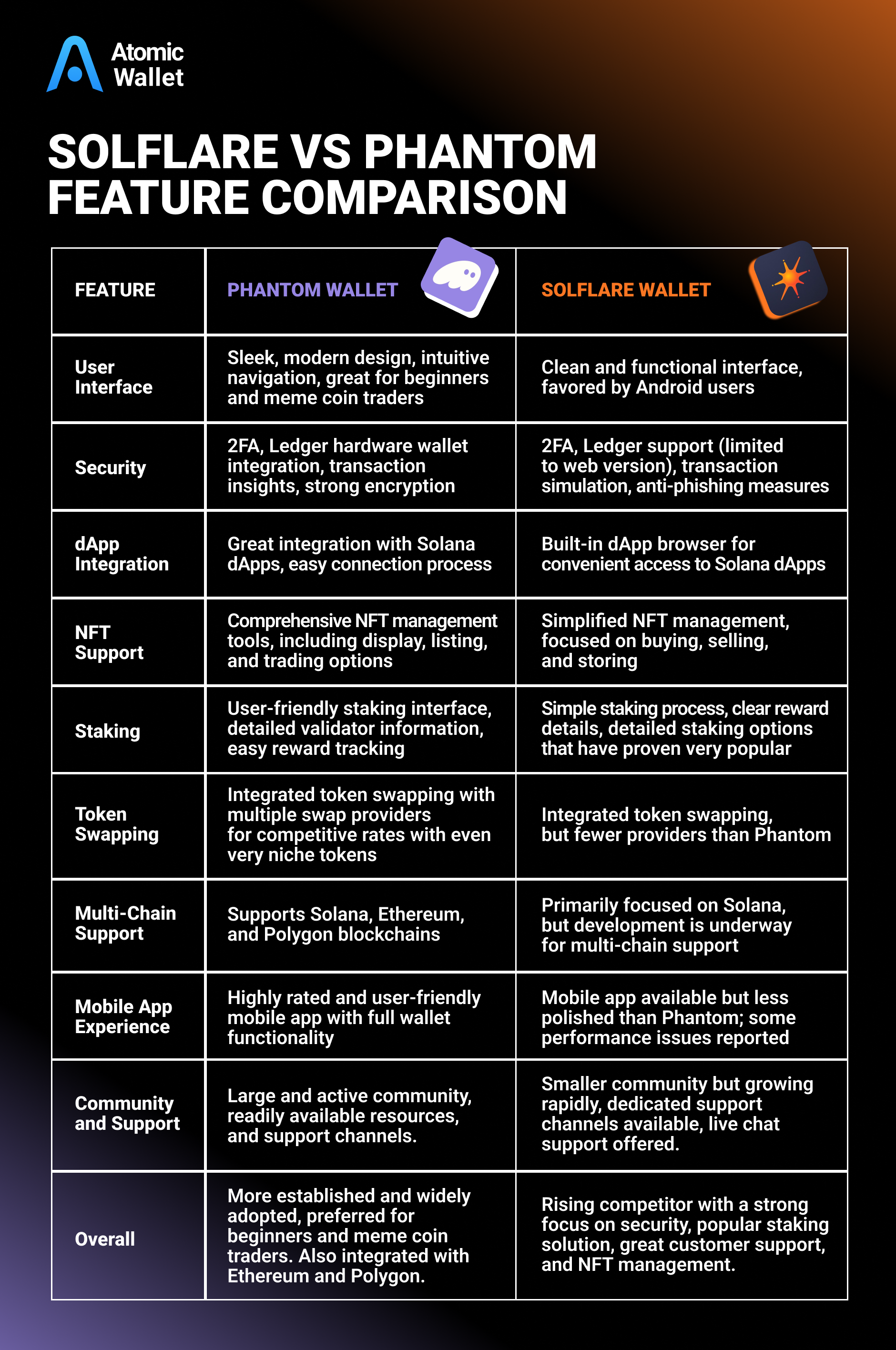
Solflare vs. Phantom: A Comparison for New Solana Users (2026)
| Criteria | Solflare | Phantom |
|---|---|---|
| Ease of Use | Generally considered straightforward, especially for newcomers. Focuses on a clean interface. | Often praised for its intuitive design and smooth user experience. |
| Security | Emphasizes security with features like Shield, and hardware wallet support. Continues to prioritize secure key management. | Strong security reputation, with ongoing development to address emerging threats. |
| DeFi Integration | Offers built-in features for staking and trading, simplifying DeFi access. Expanding integration with new protocols. | Robust DeFi integration, allowing users to interact with a wide range of Solana dApps directly within the wallet. |
| Feature Set | Provides a comprehensive suite of tools including a Magic AI Assistant, token price tracking, and card management. | Offers features like NFT viewing, transaction history, and a built-in swap functionality. |
| Community Support | Active community with growing resources and support channels. Regular updates and engagement. | Large and active community known for being helpful and responsive. |
| Customization Options | Offers some customization options for display preferences and themes. | Provides more extensive customization options, allowing users to personalize the wallet's appearance and layout. |
| Hardware Wallet Support | Supports multiple hardware wallets for enhanced security. | Supports a variety of hardware wallets. |
Illustrative comparison based on the article research brief. Verify current pricing, limits, and product details in the official docs before relying on it.
No comments yet. Be the first to share your thoughts!