
Solana Wallets: A 2026 Landscape
The Solana ecosystem has grown significantly, making wallet choice important for security and interacting with DeFi protocols and NFT marketplaces.
Wallets are typically custodial (keys held by a third party), non-custodial (you control keys), hardware (offline storage), or software (apps/extensions). Your choice depends on your needs and risk tolerance.
As Solana's ecosystem evolves, wallets need to support new features like Pay-by-Account and Token Extensions. This guide compares leading options based on security and functionality.
Custodial vs. Non-Custodial: Which Control Model?
Custodial wallets, like those from Binance or Coinbase, manage your private keys for you. This is convenient for beginners but means you trust the provider and lack ultimate control.
Non-custodial wallets put you in charge of your private keys (seed phrase). This offers maximum control and reduces risks from centralized failures, but requires you to manage your seed phrase securely.
Centralized exchanges holding keys are targets for hackers and subject to regulations. Non-custodial wallets avoid these risks by removing the intermediary.
For small, actively traded amounts, a custodial wallet may suffice. For long-term storage or significant holdings, a non-custodial wallet is recommended.
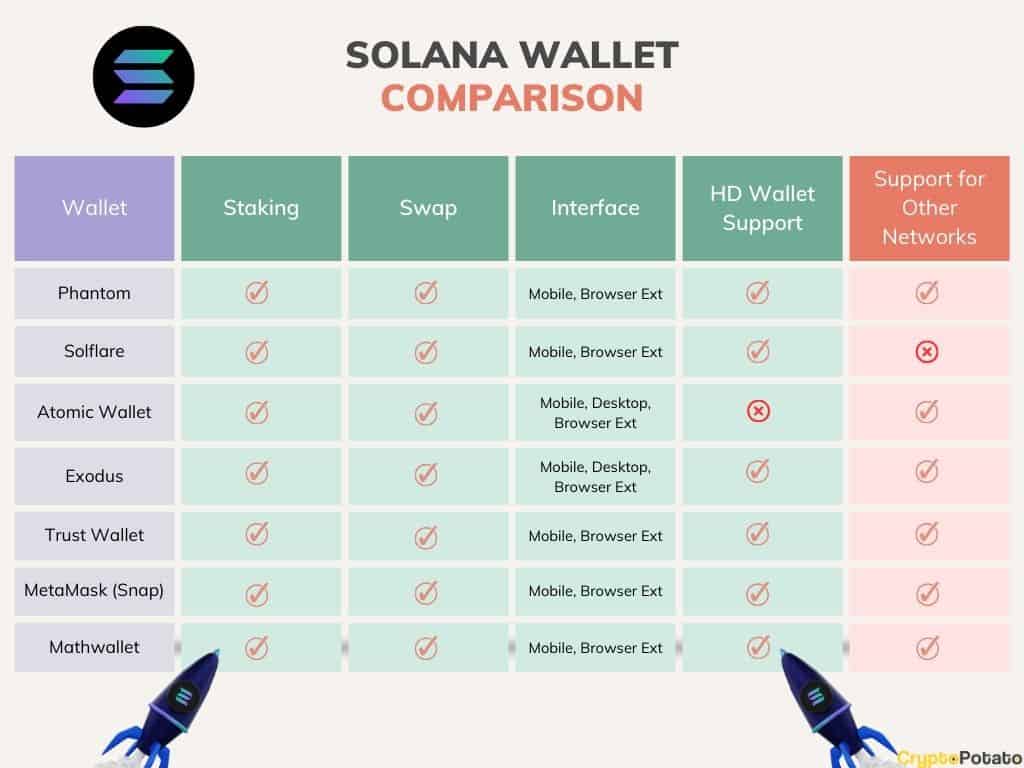
Top Solana Wallets: A Feature Comparison
Phantom and Solflare are leading Solana wallets, with Backpack gaining traction. Each offers unique features, and this section compares them to help you choose.
Phantom offers a user-friendly interface with a focus on NFTs, supporting many dApps and marketplaces. Transaction speeds are fast, but its closed-source nature is a concern for some.
Solflare, available as a browser extension and mobile app, is open-source, appealing to those prioritizing transparency. It supports hardware wallets, token swapping, and staking, though its interface is less polished than Phantom's.
Backpack emphasizes account abstraction with "Super Accounts" for complex transactions and enhanced security. It includes a built-in exchange and supports many Solana programs, rapidly gaining popularity among advanced users.
Other wallets include Sollet (web-based) and Marinade Finance's wallet (for stakers). Transaction speeds depend on network congestion, but most support major dApps and offer staking integration.
- Phantom: User-friendly, NFT focus, fast transactions, closed-source.
- Solflare: Open-source, hardware wallet support, staking integration, functional interface.
- Backpack: Account abstraction, Super Accounts, built-in exchange, newer wallet.
Solana Wallet Comparison - 2026
| Wallet Name | Custodial Status | NFT Support | dApp Browser | Security Audits (Known) |
|---|---|---|---|---|
| Phantom | Non-Custodial | High | Integrated | CertiK Tier 1 Audit (as of late 2023/early 2024 - audit status should be verified for 2026) |
| Solflare | Non-Custodial | High | Integrated | CertiK Audit (as of late 2023/early 2024 - audit status should be verified for 2026), OpenZeppelin verification |
| Backpack | Non-Custodial | High | Integrated | Multiple audits conducted by external firms (details to be verified for 2026) |
| Sollet (Extension) | Non-Custodial | Basic | External Browser Required | Open Source, community reviewed |
| Ledger (with Solana App) | Hardware Supported | High | External dApp Browser | Ledger Security Certification, Independent Security Audits (Ledger's general security certifications apply) |
| Trezor (with Solana Support) | Hardware Supported | High | External dApp Browser | Independent Security Audits (Trezor's general security certifications apply) |
Illustrative comparison based on the article research brief. Verify current pricing, limits, and product details in the official docs before relying on it.
Security Deep Dive: Risks & Best Practices
Solana wallets face threats like phishing attacks (scammers tricking users into revealing seed phrases) and browser extension vulnerabilities. Compromised seed phrases are the most significant risk.
Use strong, unique passwords managed by a password manager. Enable 2FA, preferring authenticator apps over SMS codes due to SIM swapping risks.
Hardware wallets store private keys offline, protecting against malware. Use a metal backup for your seed phrase and always verify website and extension authenticity before entering sensitive information.
Keep your wallet software updated, as updates often include security patches. Be wary of unsolicited offers or requests for your seed phrase; if it seems too good to be true, it likely is.
- Use strong, unique passwords.
- Enable two-factor authentication (2FA).
- Consider a hardware wallet.
- Back up your seed phrase offline (metal backup).
- Keep your wallet software updated.
- Be wary of phishing attempts.
Hardware Wallets & Solana: Enhanced Protection
Hardware wallets store private keys offline, isolated from your computer, preventing keyloggers or malware from stealing them. Transactions are signed on the device, keeping funds safe even if your computer is compromised.
Ledger and Trezor are leading hardware wallet manufacturers that support Solana. Setup usually involves downloading the Solana app on the hardware wallet and connecting it to your computer, then using your preferred software wallet (e.g., Phantom, Solflare) to interact with the blockchain.
Hardware wallets like the Ledger Nano S Plus and Trezor Model T cost $100-$200. This investment is justified for those holding significant SOL or actively using DeFi.
Hardware wallets require physical access to sign transactions, which is less convenient than software wallets but offers invaluable security for long-term holdings.
Mobile Wallets: Convenience & On-the-Go Access
Mobile wallets like Phantom and Solflare offer convenient on-the-go management of Solana assets, allowing you to send, receive, and stake SOL from your smartphone, useful for travelers.
Mobile devices are less secure than computers or hardware wallets, being more susceptible to theft, loss, and malware. Biometric authentication on mobile wallets enhances security but isn't foolproof.
Protect your mobile device with a strong passcode and biometric authentication. Avoid accessing your wallet on public Wi-Fi and be cautious of mobile-specific phishing attempts via SMS or push notifications.
Mobile wallet convenience comes with increased risk. Treat it like a physical wallet, back up your seed phrase securely, and store it safely.
Wallets Worth a Closer Look: Emerging Options
Harp Wallet is gaining attention for its account abstraction features and user experience, aiming to simplify transactions and improve security.
Orca Wallet, from the team behind the Orca DEX
Sirius Wallet is focused on providing a secure and user-friendly experience, with a strong emphasis on privacy. It utilizes a unique key management system designed to protect against common attacks. These wallets represent the ongoing innovation within the Solana wallet space and offer alternatives to the more established options. It's important to do your own research before choosing a wallet.
Future Trends in Solana Wallet Security
The future of Solana wallet security is likely to be shaped by several emerging technologies. Multi-party computation (MPC) wallets, which distribute private key management among multiple parties, offer enhanced security and resilience. Account abstraction, as pioneered by Backpack, allows for more flexible and programmable wallet interactions.
Improved phishing detection mechanisms are also on the horizon. Machine learning algorithms can be used to identify and flag suspicious websites or transactions, protecting users from scams. Social recovery mechanisms, where trusted contacts can help recover access to a wallet, are also gaining traction.
These advancements are still in their early stages of development, but they have the potential to significantly improve the security and usability of Solana wallets. As the Solana ecosystem continues to grow, the demand for secure and user-friendly wallets will only increase. The interplay between innovation and security will be crucial for the long-term success of the network.
It’s important to acknowledge that predicting the future is inherently uncertain. New threats and vulnerabilities will inevitably emerge. Staying informed about the latest security best practices and adopting a proactive approach to security will be essential for protecting your Solana assets.
No comments yet. Be the first to share your thoughts!