
The state of Solana automation in 2026
The increasing sophistication of the Solana blockchain is driving a surge in interest in automated trading solutions. Solana trading bots are designed to execute trades based on pre-programmed instructions, aiming to capitalize on market movements without constant human intervention. This is particularly appealing as many anticipate a bull market in 2026, where quick reactions to price changes can be highly profitable.
Solana is built for this. Fees are usually under $0.01, which is a massive jump from Ethereum's costs. This makes high-frequency trading and arbitrage actually viable for smaller accounts. But don't think a bot is a money printer. You still have to watch the charts and adjust your parameters when the market shifts.
Several types of bots cater to different trading styles. Grid trading bots place buy and sell orders at predetermined price levels, profiting from price fluctuations within a defined range. Dollar-cost averaging (DCA) bots execute regular purchases at fixed intervals, mitigating the impact of volatility. Arbitrage bots exploit price discrepancies across different exchanges, while momentum bots attempt to identify and capitalize on strong price trends. Choosing the right type of bot depends on your risk tolerance, trading goals, and market outlook.

Seven bots to watch
The Solana trading bot ecosystem is rapidly evolving. Here's a look at seven leading contenders for 2026, evaluating them based on functionality, usability, security, and unique features. It's crucial to understand these aren't endorsements; thorough research and testing are essential before deploying any bot with real capital.
Orca: Orca is a popular automated market maker (AMM) on Solana, and its API allows developers to build and integrate trading bots. It supports a wide range of trading pairs and offers a relatively straightforward interface. While Orca itself doesn't provide pre-built bots, its robust infrastructure and liquidity make it a prime platform for bot development. The benefit here is flexibility, but it requires coding knowledge.
Raydium: Similar to Orca, Raydium is another leading Solana AMM with a strong focus on speed and efficiency. Raydium's order book functionality and integration with Serum – a decentralized exchange – make it attractive for more advanced trading strategies. They have a dedicated developer program, and several third-party bots are designed to work specifically with Raydium's infrastructure.
Drift: Drift is a decentralized perpetual exchange built on Solana. It’s gained traction for its focus on derivatives trading and sophisticated order types. Drift's bot API allows for complex strategies, and the platform’s speed is a major advantage for high-frequency trading. However, perpetuals trading carries higher risk than spot trading, so it’s best suited for experienced traders.
Mango Markets: Mango Markets offers spot, perpetual, and lending markets on Solana. Its bot API is designed for algorithmic trading and allows for margin trading. Mango Markets has had past security incidents, so careful monitoring and risk management are paramount. The platform’s integrated lending functionality opens up opportunities for yield farming and more complex strategies.
Francium: Francium focuses on leveraged yield farming and automated trading strategies. It simplifies the process of borrowing and lending to amplify returns. Francium provides a user-friendly interface and pre-built bot templates, making it accessible to less experienced traders. However, leverage amplifies both potential profits and potential losses, so caution is advised.
Tensor: Tensor is a dedicated Solana trading platform and order book, quickly gaining popularity, particularly within the NFT space. It offers advanced charting tools and order types. The platform's emphasis on order flow and liquidity makes it attractive to algorithmic traders. Tensor's focus on a specific niche could be a benefit for traders specializing in Solana-based assets.
Raptor: Raptor is a newer entrant gaining attention for its focus on derivatives trading. They offer a more streamlined experience focusing on high-frequency trading. While still relatively unproven compared to established platforms, Raptor’s innovative approach and low fees make it worth monitoring. It's crucial to research and understand the risks associated with newer platforms.
Featured Products

Securely manage cryptocurrencies and NFTs · Compatible with desktop and Android devices · Matte Black finish
This hardware wallet offers robust security and seamless integration, crucial for safeguarding assets managed by Solana trading bots.

Securely manage all crypto assets · Bluetooth enabled for mobile connectivity · Onyx Black color
This hardware wallet offers robust security and seamless integration, crucial for safeguarding assets managed by Solana trading bots.

Passphrase and Secure Element protection · Buy, store, and manage digital assets · Solar Gold finish
This hardware wallet offers robust security and seamless integration, crucial for safeguarding assets managed by Solana trading bots.
As an Amazon Associate I earn from qualifying purchases. Prices may vary.
Why you must backtest every strategy
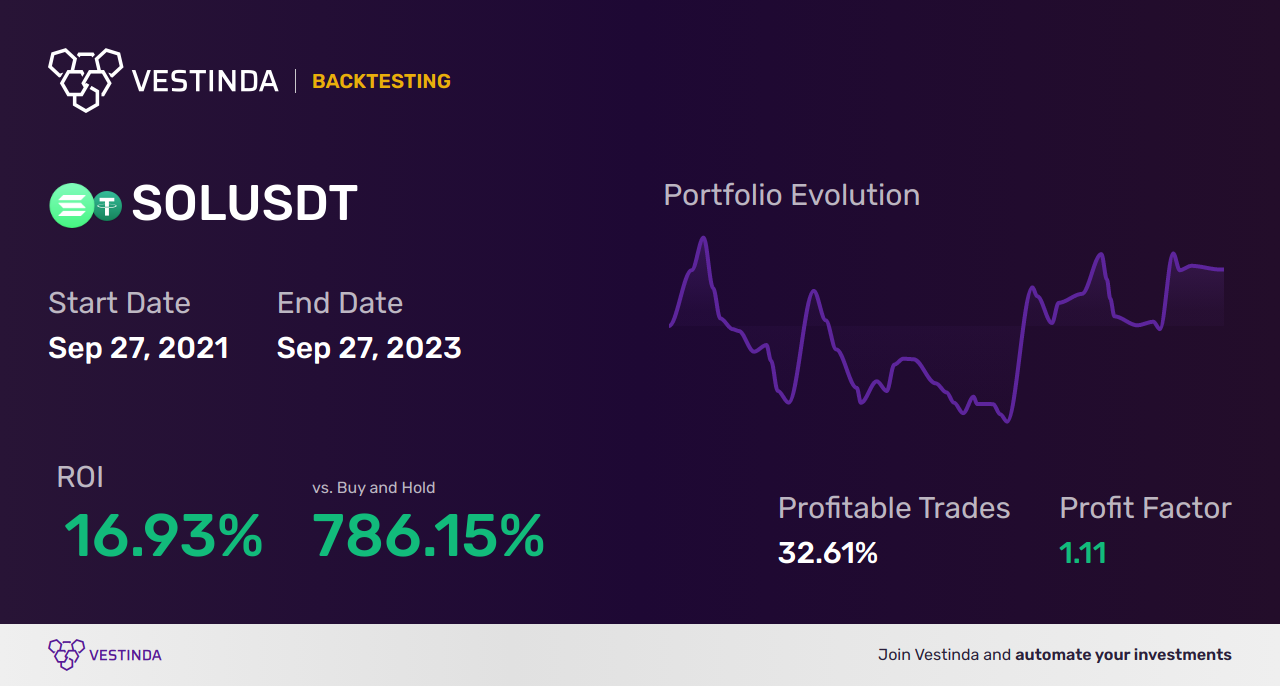
Run your strategy against historical data before you put a single dollar at risk. I've seen too many traders lose their stack because they didn't check how their bot handled the 2024 volatility. Simulating your trades helps you find the holes in your logic before the market finds them for you.
Interpreting backtesting results requires understanding key metrics. Profit factor (gross profit divided by gross loss) indicates the strategy’s overall profitability. A profit factor above 1 suggests the strategy is profitable. Drawdown measures the peak-to-trough decline in equity, indicating the maximum potential loss. Win rate shows the percentage of winning trades. A high win rate isn’t always desirable; a strategy with a lower win rate but higher average win size can still be profitable.
Common pitfalls to avoid include overfitting – optimizing the strategy to perform well on a specific historical dataset but failing to generalize to future market conditions. Survivorship bias – only using data from exchanges that still exist, potentially skewing results. Finding reliable historical Solana price data can be challenging; several data providers offer APIs and datasets, though costs vary. Look for data with high resolution and minimal gaps.
Remember that past performance is not indicative of future results. Backtesting provides valuable insights, but it’s not a crystal ball. Market conditions change, and a strategy that worked well in the past may not perform as expected in the future. Consider testing your bot on different timeframes and market scenarios to assess its robustness.
Keeping your SOL safe
Trading bots introduce unique security risks. Protecting your Solana (SOL) and other assets is paramount. The most critical step is securing your private keys. Never share your private keys or seed phrases with anyone. Utilize a hardware wallet (Ledger, Trezor) to store your keys offline, safeguarding them from online attacks.
Smart contract vulnerabilities pose another threat. Bots interact with smart contracts on the Solana blockchain, and flaws in those contracts could lead to loss of funds. Carefully review the bot’s code (if possible) and research the developer’s reputation. Look for bots that have undergone security audits by reputable firms.
API key security is also crucial. Many bots require API keys to access your exchange accounts. Treat these keys like passwords – store them securely and never share them publicly. Use strong, unique passwords for all your accounts and enable two-factor authentication (2FA) whenever possible. Regularly review your API key permissions and revoke any unused keys.
While auditing a bot’s smart contract is complex, even a high-level review can reveal potential red flags. Look for clear documentation, a well-defined code structure, and a history of security updates. If you’re not a developer, consider seeking help from a security expert.
- Keep your private keys on a hardware wallet like a Ledger.
- Enable two-factor authentication on all accounts.
- Regularly review and revoke API keys.
- Check the developer's history and look for recent code audits.
How grid trading works on Solana
Grid trading is a popular strategy for Solana bots, particularly in volatile markets. It involves placing a series of buy and sell orders at predetermined price intervals, creating a “grid” around a base price. The bot profits from the spread between these orders, buying low and selling high as the price fluctuates within the grid.
The primary advantage of grid trading is its ability to profit in both rising and falling markets. It’s well-suited for range-bound conditions, where the price oscillates within a defined range. However, grid trading can underperform in strongly trending markets, as the price may move beyond the grid's boundaries, resulting in missed opportunities or losses.
Optimizing grid parameters is crucial. Grid size determines the distance between each order level; smaller grids capture more frequent but smaller profits, while larger grids capture fewer but potentially larger profits. Order size determines the amount of SOL traded at each level. Price range defines the upper and lower limits of the grid. These parameters should be adjusted based on market volatility and your risk tolerance.
Different grid trading bot implementations exist. Some bots allow for dynamic grids that adjust to changing market conditions, while others use static grids. Some bots also offer advanced features like trailing stops and take-profit orders. Consider your trading style and market conditions when choosing a grid trading bot.
Complex strategies for experienced traders
For experienced traders, exploring more complex strategies can unlock additional profit potential. Arbitrage bots exploit price differences for the same asset across different Solana exchanges. This requires extremely fast execution speeds and low transaction fees—Solana’s architecture is well-suited for this. However, competition is fierce, and profits can be small.
Mean reversion strategies assume that prices will eventually revert to their historical average. These bots identify assets that have deviated significantly from their mean and bet on a price correction. This requires careful statistical analysis and risk management. Momentum trading focuses on identifying assets with strong price trends and riding those trends until they reverse.
Implementing these strategies effectively requires sophisticated tools and data analysis. Access to real-time market data, charting software, and backtesting platforms is essential. Integrating bots with external data sources, such as social media sentiment analysis or news feeds, can provide additional insights.
These more advanced strategies come with increased risk and complexity. Thorough research, testing, and risk management are even more critical. Consider starting with smaller capital allocations and gradually increasing your position size as you gain confidence.
No comments yet. Be the first to share your thoughts!